This post introduces a transformative project in Islamic scholarship that leverages modern computational methods to enhance Hadith research and make it more accessible to scholars worldwide.
Hadith literature, representing the sayings, actions, and approvals of Prophet Muhammad (PBUH), constitutes one of the most important foundations of Islamic scholarship. However, most existing digital Hadith repositories rely on basic keyword-based searches, which limits their potential for serious academic research.
This project aims to create an integrated digital Hadith system that combines advanced search technologies, graph-based chain analysis, and collaborative scholarly tools. The goal is to unify the entire Hadith corpus in a single structured database while integrating modern computing methodologies like Graph Theory, semantic indexing, and topic tagging.
Current Challenges in Digital Hadith Research
Hadith sciences have always maintained a rigorous tradition of critical authentication, involving textual analysis (matn), chain of transmission (isnad), and narrator evaluation (jarh wa ta’dil). While major Hadith collections have been digitized in recent decades, their search capabilities remain quite basic - mostly limited to literal keyword matching.
This represents a significant missed opportunity. Modern computational linguistics, semantic search, and relational data modeling could uncover deeper connections and support much more sophisticated scholarly workflows. This project addresses these limitations directly.
Project Vision and Objectives
The project envisions a comprehensive system that compiles all authenticated Hadiths into one unified digital repository. Key features include:
- Complete Source Integration: All major Hadith collections in one place
- Detailed Narrator Profiles: Digital mapping with jarh wa ta’dil ratings
- Smart Classification: Both traditional and computational grading methods
- Duplicate Detection: Finding repeated narrations across different collections
- Variant Analysis: Comparing different versions of the same riwayat
Advanced Features
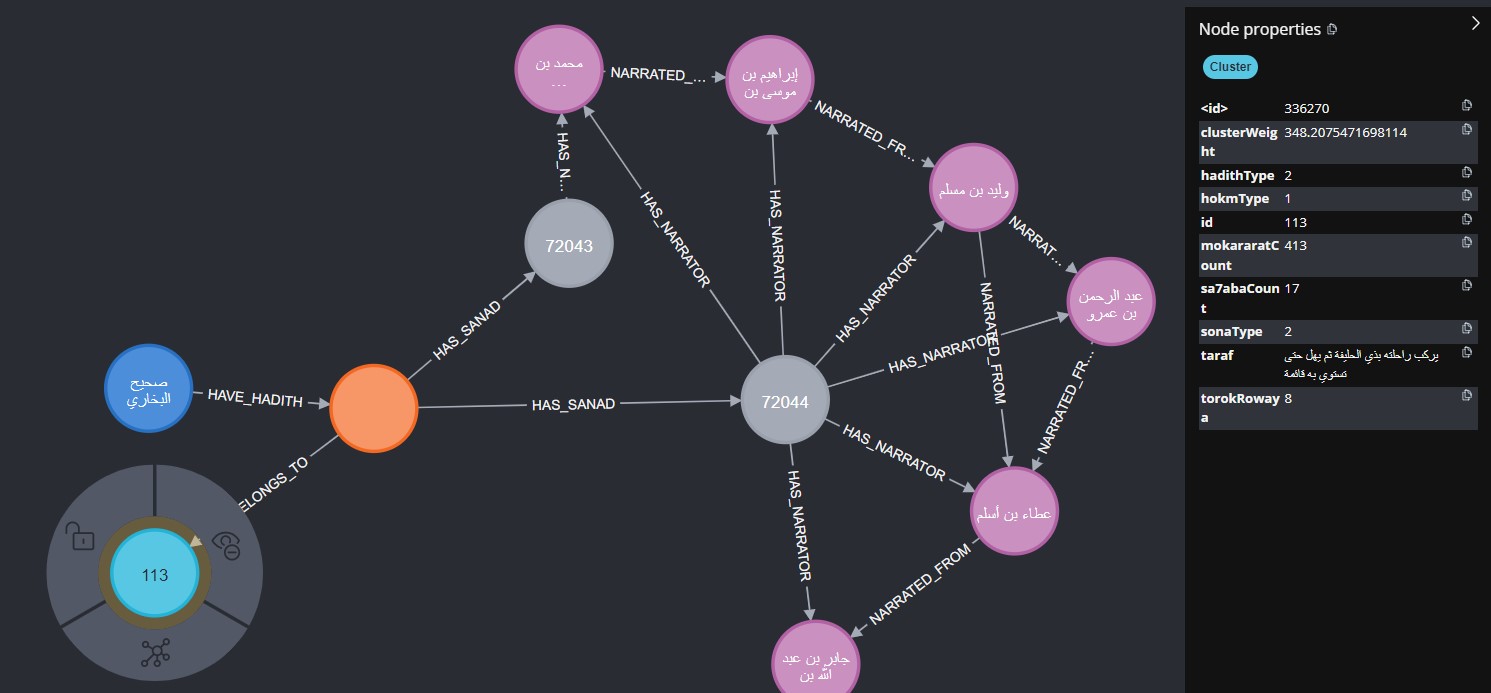
Graph-Based Chain Analysis: The system will trace and display all possible turuq (paths of transmission) for each Hadith using graph-based modeling. This enables visualization of narrator networks and network analysis to evaluate transmission chain reliability. The approach facilitates identification of weak links or rare connections that require closer examination.
Semantic Search: Beyond basic keyword matching, the system incorporates semantic search capabilities that understand contextual meaning. The platform handles different word forms, linguistic variations, and enables topic-based searches rather than just specific word matching.
Collaborative Research Platform: The system serves as a collaborative space where religious scholars and computer scientists can work together, contributing to ongoing research and innovation in the field.
Methodology
The project begins by digitizing and encoding Hadith collections in a standardized format, including major Sunni and Shia sources where relevant. The technical architecture combines relational and graph databases to handle both textual content and complex relationships between narrators.
Technical Implementation
The project incorporates several key technologies:
- Natural Language Processing: For semantic search and morphological analysis
- Graph Theory: Modeling narrators and chains as nodes and edges
- Advanced Algorithms: Using centrality, clustering, and path analysis for reliability assessment
- User Interface: A responsive web design with interactive visualizations
Expected Impact
The project aims to deliver several key outcomes:
- A comprehensive digital repository for Hadith literature designed for scholarly use
- A collaborative platform bridging religious scholarship and computer science
- Tools that integrate traditional scholarship with modern computing capabilities
- Advanced search capabilities that surpass simple keyword matching
- Educational resources for students in Islamic studies and technology
Long-term goals include establishing a dedicated Hadith research unit at Salahaddin University to ensure the project’s sustainability and academic impact.
Conclusion
This project bridges classical Islamic scholarship and modern technology by integrating advanced database design, natural language processing, and graph theory to transform Hadith research methodologies.
The initiative represents more than a simple tool - it aims to create sustainable infrastructure for preserving and studying one of Islam’s most important textual traditions in the digital age. The project brings together diverse expertise from religious scholars, computer scientists, and students working toward common research objectives.
This marks the beginning of an ongoing development process, with future updates documenting progress and findings for those interested in Islamic studies, digital humanities, and the intersection of technology with traditional scholarship.
This project contributes to digital humanities by preserving and analyzing Islamic textual heritage using modern computational methods.